Running a Game

Capes vs Cloaks Lite For the Game Master Read this once
You need the one-page rules, a few players with characters, and about two hours. This page is the rest of what a GM needs: how to pace a night, when to hand out a Level, and the rulings the one-pager leaves open. For the villain and a full worked session, run the first caper.

Pacing Is Attrition The dial you actually have

Energy refills when heroes catch their breath between combats. HP does not. A quiet scene can be that breather; a scene that ends in another fight cannot. That asymmetry is the whole pacing system. Heroes who get a breather come back at full strength; heroes pushed through three fights in an afternoon are running on bruises.

The harness measured it: three heroes sweeping four successive guard posts win 64% of the time when they catch their breath between each one, and 5% when the damage carries. To make a night feel desperate, don't add more villains. Take away the pauses.

Levels When to hand one out

A Level is +5 HP, +5 Energy, and either +2 to every stat or one power upgrade. Give one when the story has visibly turned (a villain captured, a scheme broken), never on a schedule. Three or four sessions is a comfortable pace. Go carefully past Level 3: the gap between a party and a villain moves the odds faster than any single stat, and the caper's sizing table shows how fast.

Encounter Balance Sizing a fight that ends

Want a short fight? Bring henchmen or damage-built peers. Six henchmen against three heroes is over in about four rounds, and the heroes should win it. A crew built like heroes who spent their Levels on damage also fights fast. A crew built on stats and soak drags the same scene past round ten.
Invulnerability on a high-Level villain is the grind engine. Toughness stacks with the armour and hero damage collapses to the 2-point minimum. Give a boss meant to fall fast a different second power.
A lieutenant built like a hero is worth about four henchmen. Two damage-built Level 2 lieutenants and three henchmen beat a three-hero party nine times in ten. The simulator measured it. The shape looks far more modest than it is.

What You Need On the table

Percentile dice and a few d6s and d8s. The one-page rules. Character sheets, either the party's own or the Capes and Cloaks rosters printed as pre-gens. The Chairman, whose card is on the caper, and a fistful of henchmen. That is the whole kit.
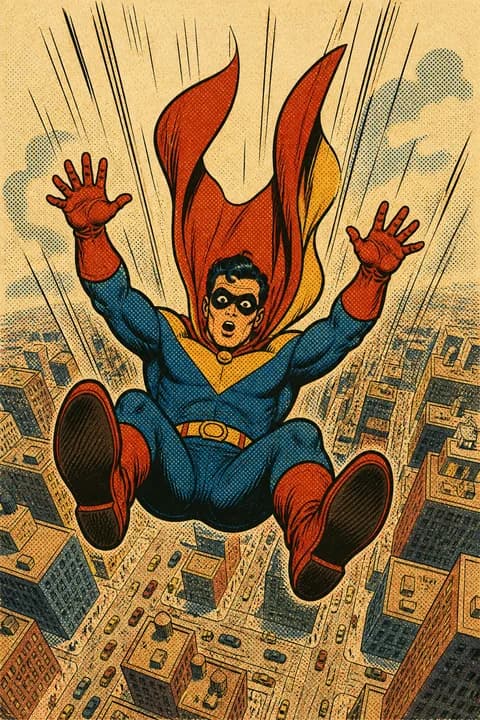
A masked superhero falling toward the city below

Falling! Look out below

1d8 per 30 ft · max 4d8

Resolve it through the normal damage pipeline: Invulnerability or Roll With the Punch, then Force Field and HP; make the usual Knocked Out check at half HP or less. Do not add Fly Back damage; the impact is already the fall.

A Grab cannot become a same-turn flight-and-drop: while it is maintained, neither character can move or attack. For a cinematic carry, require an action to Grab, a later move to fly upward within the hero's carrying capacity, and the villain's normal chance to break free with Brawn. Releasing them is free and the fall resolves immediately; a villain cannot Blast while still grabbed.

Rulings The questions that come up first

Does Dodging help against Mind Push or Phantasm? No. Both resolve as Will saves, and Dodge only imposes disadvantage on attack rolls. Dodging will not protect against the mental power, though it may still protect the hero from other attackers until their next turn.
Can a grabbed character Dodge? Yes. Dodging is neither moving nor attacking, the two things a grab actually stops. They still can’t break free without a Brawn save on their turn.
Is there a grid? No. Distances are fiction: 30 ft means "across the room", 50 ft means "across the street", and the only question that matters is whether someone can reach you this turn. The balance harness ignores position too, so none of the maths depends on it.
What happens on a natural 00? It always fails, whatever the number needed. That is the game’s only automatic failure. There is no critical hit table, and adding one won’t break anything.
Someone tried a caper stunt I did not plan for. Pick the stat that fits and have them roll under it. Easy things need no roll; hard things roll at disadvantage; a genuinely clever plan earns advantage. Say yes when you can. The combat rules are where this game keeps its teeth.
How long does a power take? Using an active power takes your action. Passive powers and effects explicitly marked free still work as written: Invulnerability is always on, and Telepathy’s mind-to-mind speech is free. If a power is not marked passive or free, it uses an action.
A player wants to kill someone. That call belongs to each player, and only for their own character. A villain at 0 HP is out of the fight, and nobody dies unless the table agrees to it. Restraining an incapacitated villain is an action, and that is the capture.